⏱ 15 min read
In the modern age, a singular, persistent message is dictated to us from every corner: “You first.” Today’s consumer culture and success-oriented systems command individuals to place their own desires at the center of everything.
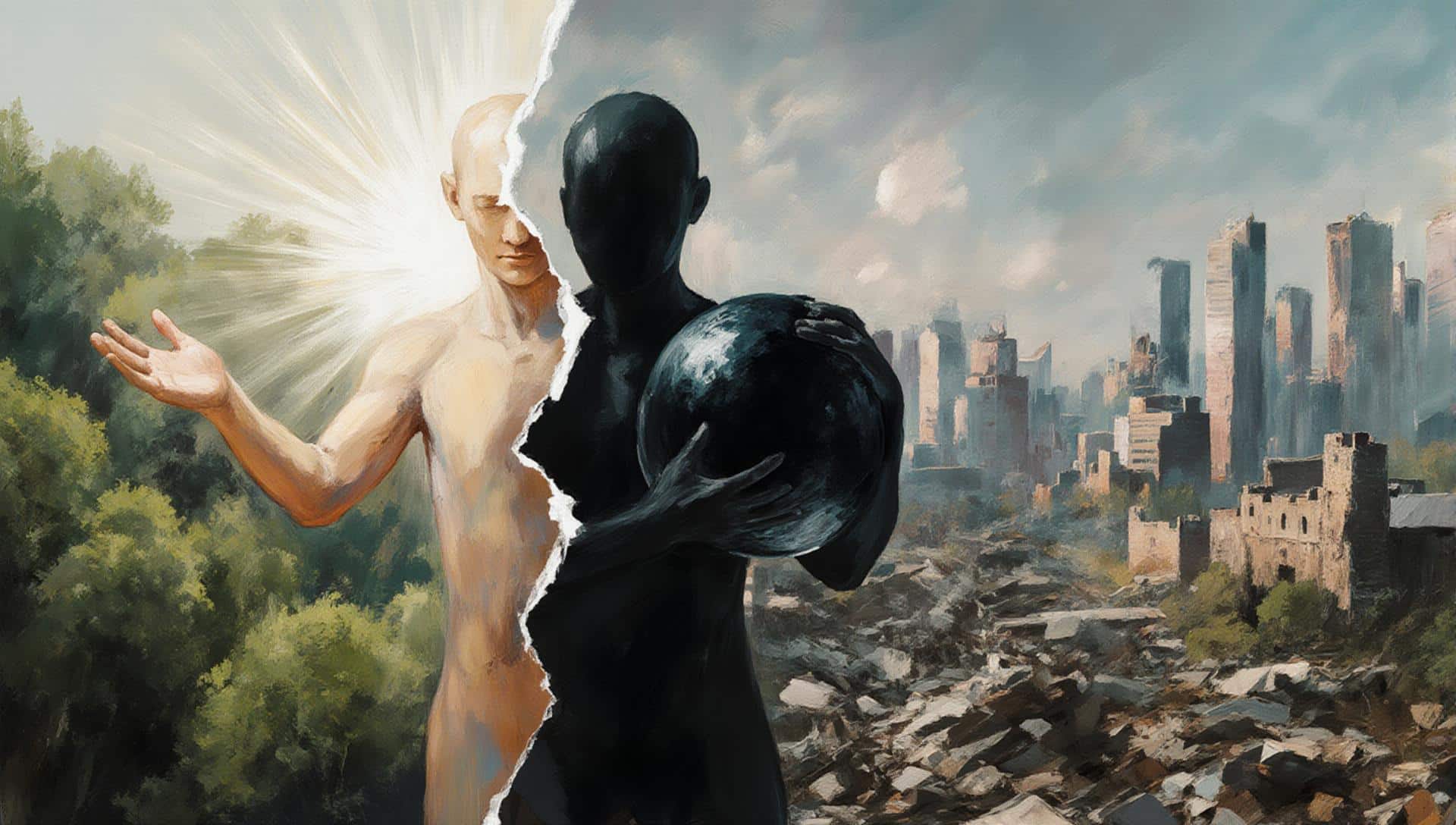
Modern man—viewing his existence as merely flesh and bone and the world as a collection of blessings revolving around him—finds himself imprisoned in a terrifying state of selfishness and loneliness. However, the millennia-old wisdom of humanity and spiritual sources proclaim a vastly different truth: the pinnacle of spiritual evolution, or evolutionary progress (tekâmül), lies in abandoning the “I” to embrace the “We”—it lies in Altruism (selflessness).
In a world woven with coarse materialism and ruthless competition, altruism is not a mere weakness, naivety, or a moral suggestion. On the contrary, it is the most noble, elegant, and conscious rebellion against a system that screams “me first.” When we examine the anatomy of this cosmic rebellion through the light of esoteric, spiritual, and Sufi sources, we clearly see that selfishness is a mechanical illusion that must be transcended.
The Illusion of Self and the Malady of “Internal Considering”
At the root of individualism and selfishness lies a massive fallacy: the assumption that a human being is a distinct, separate, and unchanging “I,” apart from the universe, the Whole, and other people. As Maurice Nicoll elaborates in his monumental work, Psychological Commentaries on the Teaching of Gurdjieff and Ouspensky, there is no single “I” within a person; rather, a person is a crowd of countless contradictory “I”s. Unless one realizes this mechanical nature, they remain a slave to a false personality (egos).
“For a person to break free from mechanicalness, they must abandon ‘internal considering’ and transition into the practice of ‘external considering‘ based on altruism.”
“For a person to break free from mechanicalness, they must abandon ‘internal considering’ and transition into the practice of ‘external considering‘ based on altruism.”
Nicoll explains the most dangerous manifestation of selfishness in daily life through the concept of “Internal Considering.” This is the state where a person constantly worries about how others treat them, feels insufficiently appreciated, and is preoccupied with their own importance.
They perpetually keep “internal accounts” against others. As one believes the world owes them or has been unfair to them, they leak a staggering amount of energy. Master Ergün Arıkdal defines this state through the concepts of “identification” and “Nefsaniyet” (the lower-self/egoism).
According to Arıkdal, nefsaniyet is self-worship—placing one’s own interests above all else. As a human “identifies” with their clothes, bank account, pains, or grudges, they lose their freedom and continue to live in a state of sleep.
“While the world screams ‘Me First,’ altruism is the silent, elegant revolution of free souls who can say ‘You First’.”
“While the world screams ‘Me First,’ altruism is the silent, elegant revolution of free souls who can say ‘You First’.”
External Considering: The Art of Putting Oneself in Another’s Place
The sole remedy for individualistic pride and the sickness of internal considering is the practice of “External Considering,” emphasized by Maurice Nicoll and the Fourth Way teachings. External considering is not merely looking polite on the outside or performing superficial acts of kindness. It is the ability to consciously put oneself in another’s shoes, feeling their difficulties, pains, and limitations internally.
If a human can see themselves in the other, and the other in themselves, violence and judgment come to an end. A person who realizes that the same mechanicalness and weakness they criticize in others also exist within themselves reaches true compassion. This is the psychological and cosmic application of the Golden Rule: “Do unto others as you would have them do unto you.” Knowing another’s trouble as one’s own is the first door opening from the narrow dungeon of selfishness toward universal understanding.
“Every hand you extend to another is actually a hammer blow intended to break the rusted chains of selfishness within yourself.”
“Every hand you extend to another is actually a hammer blow intended to break the rusted chains of selfishness within yourself.”
Conscience and the Conflict of Nefsaniyet as the Fuel of Growth
Why does the ego (nefsaniyet), which pulls humans down so much, exist in the first place? The Divine Order and the Universe (Ilahi Nizam ve Kainat), a masterpiece compiled by Dr. Bedri Ruhselman, the pioneer of metapsychic research in Turkey, opens a magnificent horizon here. Nothing in the universe is redundant. Nefsaniyet is a perfect “stone of resistance” placed to spur the soul’s efforts and drive the individual toward “comparative knowledge.” Ruhselman explains this with the analogy of an axe breaking wood: if the wood offered no resistance, the axe would not be necessary. Nefsaniyet is that resistance.
The cosmic mechanism that enables a human to emerge from this dungeon of selfishness and reach altruism is “Conscience.” According to the teachings of The Divine Order and the Universe, conscience is not a static social moral rule but a living “duality.” While the lower end of conscience pulls us toward selfishness, the upper end pushes us toward considering others and self-sacrifice.
When a human caught between a selfish act and altruism chooses to serve others, the level of their conscience rises. As one suffers or causes suffering, they grasp the dissatisfaction of selfishness and must cling to the sense of duty—altruism—to find peace.
“True altruism is the alignment of the being with the ‘Sense of Duty’ by renouncing its own nefsaniyet; for every effort that does not serve the Whole is a stone of resistance on the path of evolution.” (Also read: Conscious Effort)
“True altruism is the alignment of the being with the ‘Sense of Duty’ by renouncing its own nefsaniyet; for every effort that does not serve the Whole is a stone of resistance on the path of evolution.”
“Service” as True Religion and Universal Brotherhood
The practical manifestation of transcending individualism and turning toward the Whole is selfless service. In the Silver Birch teachings, which stem from the spirit world and contain deep wisdom, this is expressed with extraordinary simplicity. Silver Birch states that religion is not the dogmas designed by priests and rabbis; true religion is “serving” with love, compassion, and mercy wherever an opportunity is found. According to him, “Service is the true coinage of the soul.” When a human helps another, wipes away a tear, or becomes a light to those in darkness, they allow the Divine Spirit within to manifest. Silver Birch insistently emphasizes that one cannot reach a spiritual peak by living selfishly; the purpose of life is to multiply our spiritual riches by distributing them. (Also read: Spiritual Alchemy)
We find the same universal echo in the White Eagle teachings. White Eagle says, “There is no separation in love.” He describes all humans as brothers climbing from the foot of a mountain toward the summit, asserting that those above should never look at those below with criticism, but only with love. True service must be performed not for praise, fame, or the expectation of heaven, but with a pure sense of duty. As clearly stated in the Sadıklar Planı (Plan of the Loyal Ones) spiritual communications, serving others is “one of the distinguishing characteristics of humanity.” This service is a person quietly pushing a stone off the road without making a show, supporting the Whole with the thought that it is beneficial for their own evolution. This stage, defined as the “Reality of the Intuition of Duty-Knowledge” in Master Ergün Arıkdal’s work Tekâmül (Evolution), is the performance of an action simply because it is for the “good of the Whole,” driven by a natural sense of necessity.
“True wealth is not what you have accumulated, but the spiritual treasures you can distribute to others without fear of depletion.” “Altruism is the true currency of the soul. To lighten another’s burden is to carry your own spiritual light into the dark corners of the universe.”
“True wealth is not what you have accumulated, but the spiritual treasures you can distribute to others without fear of depletion.” “Altruism is the true currency of the soul. To lighten another’s burden is to carry your own spiritual light into the dark corners of the universe.”
Wahdat al-Wujud: The Metaphysical Peak of Altruism
The moral and spiritual foundations of altruism rest upon an ontological (existential) ground in the concept of “Wahdat al-Wujud” (Unity of Being) in Islamic Sufism. The works of the great sage Ibn Arabi and his follower Seyyid Muhammed Nûru’l-Arabî proclaim that the only true existence is Allah (the Absolute Being). All existence in the universe is but a manifestation (reflection) of His names and attributes.
From this magnificent perspective, the “Face of God” is present in everything created. If existence is essentially “One,” then the separation of “me and you” created by the ego is a product of terrifying ignorance and illusion. The individualistic ego, seeing itself as separate, can harm or exploit others. However, a “Perfected Man” (Kâmil İnsan) who has attained the secret of unity and reached the station of “knowing one’s self is knowing one’s Lord,” knows that every kindness done to another is done to the Whole and, therefore, to the Creator.
In the Sufi views of Muhammed Nûru’l-Arabî, the state of Melâmîlik is precisely this condition of nothingness and altruism. The seeker becomes “annihilated” from their own ego (enaniyet) and does not claim a share (reward/merit) for their worship or good deeds. They attribute every good deed to God and every fault to their own lower self. Thus, the only way to love another as oneself—or even to place the other before oneself—is to realize that the other is also a cell of the same body, originating from the same Divine Source.
“Altruism is not a sacrifice; it is the art of harmonizing one’s own voice with the universal choir. If you are missing, the symphony is incomplete. For those who attain the secret of Unity in Existence, altruism is not a choice but a necessity; for there is no existence other than God, and every kindness done to another is presented to the Face of God.”
“Altruism is not a sacrifice; it is the art of harmonizing one’s own voice with the universal choir. If you are missing, the symphony is incomplete. For those who attain the secret of Unity in Existence, altruism is not a choice but a necessity; for there is no existence other than God, and every kindness done to another is presented to the Face of God.”
To summarize: the philosophy of “individualism” and “me first,” which the modern world has turned into a virtual religion, is actually a spiritual blindness. The human who struggles within their small world for their false personality is like a discordant note against the vast harmony of the universe.
In contrast, altruism is the action of a free soul that has faced its own darkness and grasped the unity of existence. This action is to feel the suffering of the other in one’s own heart and to do all this without expecting anything in return.
Toward the Reality of Unified Humanity
Altruism stands as the most elegant, lasting, and revolutionary answer to this noisy world: to be a silent remedy for another’s pain and to look at the world through the eyes of the other.
Today, humanity is passing through great chaos, turmoil, and suffering. Within the framework of the “Existential Principles” formed by the dedicated work of Ergün Arıkdal, the castes, races, and “me vs. you” conflicts we have created on earth are completely contrary to the “Principle of Existential Equality.” The goal of social evolution is to transition from an arena where individual egos collide to a dimension where solidarity and cooperation operate as a universal law.
In Master Ergün Arıkdal’s book Tekâmül and the Sadıklar Planı communications, this is called the “Reality of Unified Humanity.” This reality, where the distinction of “your problem vs. my problem” ends, is the learning of humans to live within a collective organization by respecting the rights and evolutionary processes of others.
The planet Earth is a difficult school, a laboratory where souls come to learn this solidarity. Violence breeds violence; selfishness breeds selfishness. The awakening of mechanized man from this sleep is only possible through an altruistic act of love.
Conclusion: The Subtle Revolution of Pure Love
To summarize: the philosophy of “individualism” and “me first,” which the modern world has turned into a virtual religion, is actually a spiritual blindness, a psychological sleep, and a malady committed against the unity of existence. The human who struggles within their small world for their false personality and ego, twisting everything to their own advantage, is like a discordant note against the vast and magnificent harmony of the universe.
In contrast, altruism is the action of a free soul that has had the courage to face its own darkness, stripped away its identifications, and grasped the unity of existence. This action is to feel the suffering of the other in one’s own heart, to be able to give up one’s own comfort to light their path, and to do all this without expecting anything in return, solely by the command of conscience and universal love.
The “me first” world is a world of wars, exhaustion, loneliness, and insatiability. Altruism stands as the most elegant, lasting, and revolutionary answer to this noisy and coarse world: to be a silent remedy for another’s pain, to be able to look at the world through the eyes of the other (“external considering”), and to say “you first” with a sense of universal brotherhood. For true freedom and spiritual majesty lie not in the satisfaction of a selfish “I,” but in the service of an all-embracing “We.”
References / Bibliography
- Ruhselman, Master Dr. Bedri. The Divine Order and the Universe (İlâhi Nizam ve Kâinat). Istanbul: MTİAD Publications. (On the function of ‘nefsaniyet’ as a resistance stone for evolution and the concepts of the Duality of Conscience).
- Arıkdal, Master Ergün. Knowing Oneself (Kendini Bilmek). Istanbul: Ruh ve Madde Publications. (On identification/attachment and the ‘sleep’ of ‘nefsaniyet’ over the individual).
- Arıkdal, Master Ergün. Evolution (Tekâmül). Istanbul: Ruh ve Madde Publications. (On the reality of ‘duty intuition’ and the Reality of United Humanity).
- Enstitü Publications (Compilation). The Plan of the Faithful (Sadıklar Planı) Communications. (On service as the distinguishing feature of humanity and the law of universal brotherhood).
- Nicoll, Maurice. Psychological Commentaries on the Teaching of Gurdjieff and Ouspensky (Volumes 1-5). (On the concepts of Internal and External Considering, Multiple ‘I’s, and Mechanicalness).
- Ouspensky, P. D. The Psychology of Man’s Possible Evolution. (In the context of man as a mechanical machine and the emphasis on the state of sleep).
- Ibn al-Arabi, Muhyiddin. The Bezels of Wisdom (Fusus al-Hikam). (On the ontology of Wahdat al-Wujud / The Unity of Existence).
- Nuru’l-Arabi, Seyyid Muhammed. Al-Anwar al-Muhammadiyya fi Sharhi Risalat al-Wujud. (On the knowledge of the self, fading from ‘enaniyet’ (egoism), and seeing the Face of Truth in every atom).
- Silver Birch Teachings. The Teachings of Silver Birch. (On service as the “true currency of the soul” and unconditional love).
- White Eagle Teachings. The Teachings of White Eagle. (On the absence of separation in love and the consciousness of united brotherhood).
- Cayce, Edgar. The Edgar Cayce Readings. (On the emphasis that planet Earth is a laboratory and a school of solidarity).
Related Posts




Listen While You Read
Lucid Dream Gates — Theta Wave Dream Induction
Transcending the self through altruism — theta depth — music for moving from individual to universal consciousness.
Sonat Mundi — United Colours of Sound | Meditation & consciousness music