⏱ 10 min read
One of the greatest tests human beings face on earth is seeing things as they are — parting the illusion-veils woven by our own minds, emotions, and prejudices, and meeting life, people, and events as they truly are. Most of the time, while we believe we are observing the outer world, we are in fact watching only the reflections of our inner world, our conditioning, and our mechanical reactions.
As Master Ergun Arikdal points out in his work Knowing Oneself, the human being has gradually slipped into one-dimensional living, has tied all faculties of perception to the channel of the body, and has become like an incomplete creature trying to fly with a single wing. Without the discipline of seeing things as they are, this one-winged life perpetuates itself. This incompleteness blocks objective evaluation of events and persons. The most fundamental step of spiritual evolution is precisely the virtue of accepting everything as it is.
Why We Cannot See Things as They Are: The Filter of Perception
The deepest obstacle to seeing things as they are lies in our illusion about our own wholeness. As P. D. Ouspensky explains in The Psychology of Man’s Possible Evolution, the first thing a person must know is that he is not “one”; rather, he is composed of countless changing “selves.” Because we hear the same name and inhabit the same body day after day, we believe we possess a continuous, unchanging ego. This illusion betrays us not only inwardly but also when we try to evaluate other people and events.
As Maurice Nicoll emphasizes in Psychological Commentaries on the Teaching of Gurdjieff and Ouspensky, at the level of the sleeping man’s consciousness everything appears subjective; whereas at the fourth level — the objective state of consciousness — everything is seen as it truly is, and there is no room for any illusion or deceptive appearance. As long as we evaluate other people through the associations we have built about them — that is, through images stored from the past — we will never really see them; we will only keep them imprisoned in our own associations. The very practice of seeing things as they are begins with releasing these inherited images.
Seeing Without Judging: The Inner Mirror of Criticism
The path to accepting another human being as they are runs through abandoning judgment and criticism. When we criticize others, we are in fact projecting onto them the dark spots within ourselves. As the spirit guide White Eagle gently reminds us in The Quiet Mind, you cannot judge another being; you cannot know that person’s previous lives, the karmic burden that drives them to act as they do, or whether they are an instrument of the higher Lords of Karma. To meet another’s invisible heart-wounds and weariness with understanding is to choose love itself.
Nicoll, again in the same commentaries, suggests that when we recognize that everything we criticize in others is also alive within us, the consciousness shifts from its subjective state into the objective. When we begin to see our neighbor in ourselves and ourselves in our neighbor, a real expansion of consciousness occurs, and judgment becomes impossible. In modern psychology Carl Rogers’s principle of unconditional positive regard stands as the therapeutic counterpart of this very truth: the way to transform a human being is to stop judging and to receive them wholly. Seeing things as they are, in this light, is itself an act of love.
Cosmic Law in Events: The Principle of Causality
To see the events that meet us in life as they are demands a deep reverence for cosmic law and the principle of causality (cause and effect). We tend to see only the surface, the painful aspect of events. Yet as Bedri Ruhselman underlines in The Spirit and the Universe, even within the seemingly catastrophic outcomes of an earthquake that overturns whole cities, a vast flood, or a volcanic eruption, there are hidden meanings that serve humanity as practical lessons.
When human beings stop wrestling with the coarse sensory side of events and ascend instead through the knowledge of universal laws and the principle of causality, they begin to understand the language events speak. Every event is an opportunity for experience set before the soul on its evolutionary path. As stated in The Divine Order and the Universe, even the most ideal feelings and actions a human encounters in this world — those we count as supra-material — are in truth functions of matter at heightened fluidity; every contrast in nature is a tool for the soul to awaken its conscience through comparative knowledge.
The voice of this same insight in ancient philosophy is Stoicism. In Epictetus’s Enchiridion, that famous principle — “Men are disturbed not by the things that happen, but by the judgments they form about them” — is the clearest Western expression of the principle of causality. Marcus Aurelius continues the same line in his Meditations: turning toward our reaction rather than the event is the only true field of human freedom. Ancient spiritual knowledge and Hellenistic philosophy whisper, in different tongues, the same truth: seeing things as they are is the gateway to inner freedom — and seeing things as they are is the first step that opens it.
Understanding this cosmic order also requires flexibility and harmony. As Arikdal explains in Positive Living, the capacity for harmony is the ability to bend with every material change, every rise and fall in the cosmos; this is the highest mark of an intelligent and conscious being. Resistance to events does nothing but multiply suffering. By the law of the pendulum, life forever swings between opposites. Until we accept that painful events are necessary for our own evolution, we will keep on calculating, complaining of injustice. Yet every experience is the very evolutionary material we are meant to work upon. Seeing things as they are means recognizing each event as a deliberate offering on the path.
Sufi Acceptance: Witnessing the Divine Manifestation
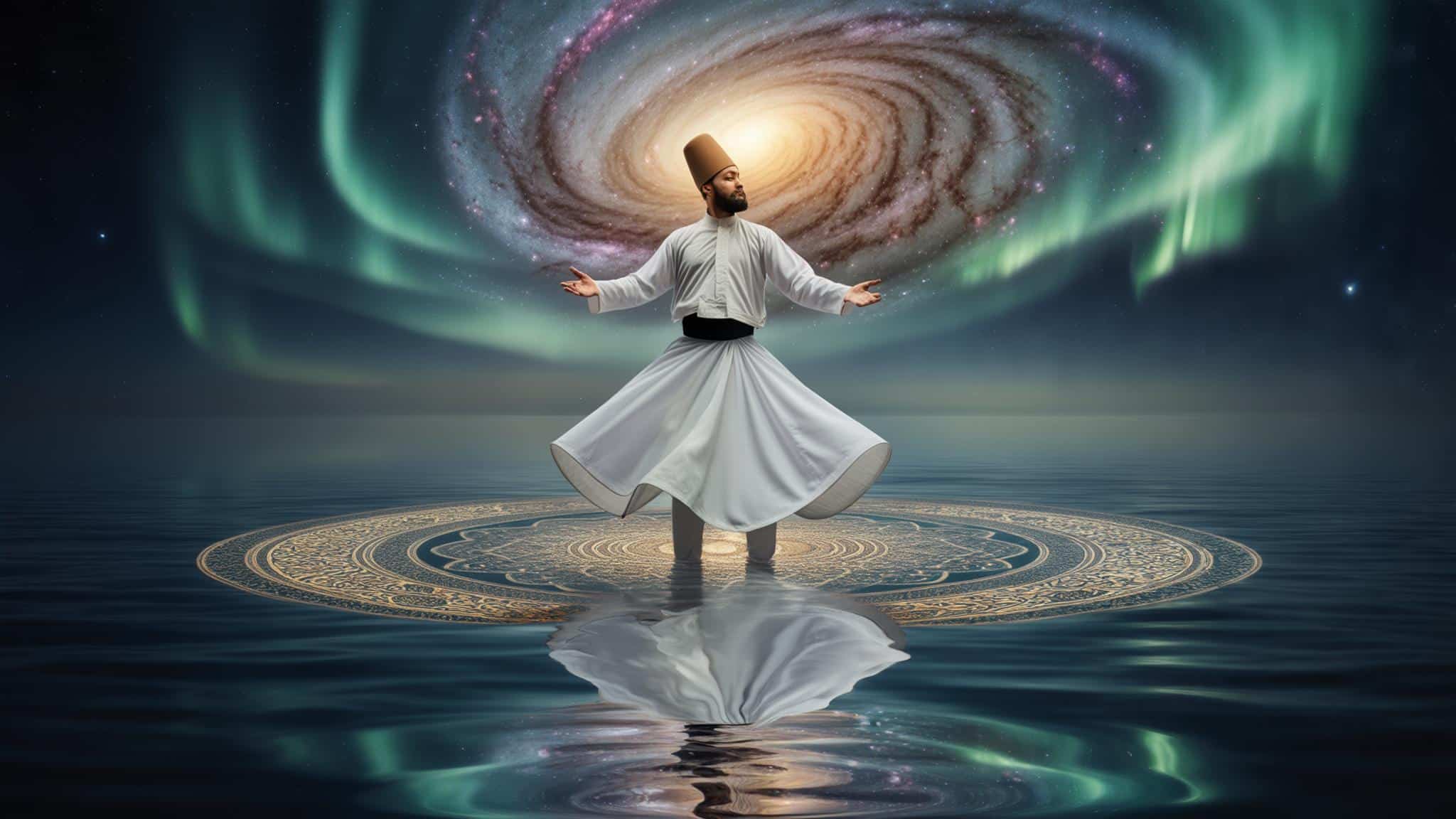
From the Sufi and esoteric perspective, seeing things as they are means witnessing the manifestation (tajalli) of the Creator in everything and surrendering to the divine will.
As Muhyiddin Ibn Arabi underlines in The Bezels of Wisdom (Fusus al-Hikam), the one who reaches the station of surrender and contentment sees the Reality behind events; stripped of his own will and attributes, he accepts everything as the act of God.
The perfected human, who sees existence with the eye of the Real, evaluates each encounter as a manifestation, and frees his heart from the discomforts of talwin (the constant change of inner states), becoming free of sorrow. In this sense, seeing things as they are and witnessing tajalli are one and the same act. This deep acceptance begins when a person realizes that his own partial existence is, before the Absolute, nothing.
The Practical Method for Seeing Things as They Are: The “Observing Self”
So how do we reach this state of acceptance and of seeing events as they are? The only practical method is to undergo an inner separation and to watch ourselves without judgment. As Arikdal stresses in Knowing Oneself, until the human being divides himself into the “Observing Self” and the “Observed Side,” he can never move from where he stands. We must watch the moods, thoughts, lies, and excuses that flow through us as if from outside, like a spectator at a film. Only then does seeing things as they are become a lived reality rather than a theory.
A beautiful metaphor for this inner separation is hidden in the saying “You are the sky; everything else is just the weather”: consciousness is like the steady sky, while thoughts and feelings are passing clouds. As Maurice Nicoll points out, the Observing Self takes no side; it is utterly pure, plain, a non-critical camera. When we observe ourselves without criticism and without trying to justify, we let a beam of light slip into the dark corners of our inner world; that light heals us by enabling us to accept life as it is.
In modern psychology, Tara Brach’s work on Radical Acceptance demonstrates that mindfulness practice operates precisely through this non-judgmental witnessing: in the moment we suspend judgment, inner resistance dissolves and transformation begins of itself. This is precisely how seeing things as they are heals: judgment dissolves, presence returns.
To realize that, in reacting to an emotional or mental event, the reaction is not actually “us” — that is the key to freedom. If we cannot transform the impressions life leaves upon us, we remain mere machines governed by external phenomena. Viktor Frankl’s words, distilled from his concentration camp experience, are perhaps the most powerful expression of this principle: “Between stimulus and response there is a space. In that space lies our power to choose our response. In our response lies our growth and our freedom.” To insert consciousness into that space is to make the gap visible. When we manage this, we embrace not only the flaws of others but also the contradictions within ourselves with kindness. Seeing things as they are, then, is not a single insight but a daily exercise of pausing in that gap.
As Michael Newton’s compiled work Destiny of Souls describes the way our lives are reviewed when we cross over into the spirit realm: even there, advanced beings examine our experiences not with a judging authority but with infinite tolerance, patience, and absolute love. Non-judgment is not merely a worldly virtue; it is, as it were, the very language of the cosmos — the cosmos itself is in the business of seeing things as they are.
From False Self to Wholeness: The Liberation of Seeing Things as They Are
In short, seeing life, people, and events as they are — and accepting them — is neither passive submission nor weakness. On the contrary, it is the human being’s active integration with the universal and divine order, having stepped out of the narrow prison built by the ego (the false personality). When we realize that every person around us is waging their own justified evolutionary struggle within their own confusion, and that every event arising in nature has been designed for our spiritual growth, the violence and anger in our hearts give way to a deep compassion. Seeing things as they are, we discover that compassion was hidden inside acceptance all along.
Every individual who advances on the path of self-knowledge, when they grasp their own nothingness through non-critical observation, will reach the mastery of accepting life — in all its dimensions — with serenity and love, embracing the immense richness of cosmic wholeness. Seeing things as they are — that is, looking without veils — is the only key to freedom and to love.
REFERENCES
- Arikdal, Ergun. Knowing Oneself (Kendini Bilmek). Ruh ve Madde Yayınları.
- Arikdal, Ergun. Positive Living (Pozitif Yaşam). Ruh ve Madde Yayınları.
- Aurelius, Marcus. Meditations.
- Brach, Tara. Radical Acceptance: Embracing Your Life with the Heart of a Buddha. Bantam, 2003.
- Epictetus. Enchiridion.
- Frankl, Viktor E. Man’s Search for Meaning.
- Ibn Arabi, Muhyiddin. The Bezels of Wisdom (Fusus al-Hikam).
- Newton, Michael. Destiny of Souls.
- Nicoll, Maurice. Psychological Commentaries on the Teaching of Gurdjieff and Ouspensky.
- Ouspensky, P. D. The Psychology of Man’s Possible Evolution.
- Rogers, Carl. On Becoming a Person: A Therapist’s View of Psychotherapy.
- Ruhselman, Bedri. The Divine Order and the Universe (İlahi Nizam ve Kâinat).
- Ruhselman, Bedri. The Spirit and the Universe (Ruh ve Kâinat).
- White Eagle. The Quiet Mind.