⏱ 11 min read
The soul’s two wings: the awakening of true conscience between the ego’s false freedom and its false responsibility
The late and beloved psychologist Doğan Cüceloğlu, in a profound post he once shared on social media, holds up a magnificent mirror to one of the deepest dilemmas of human nature. The balance of freedom and responsibility — the most ancient test the soul faces — stands at the very heart of this dilemma.
Before we begin our spiritual analysis, summarizing Cüceloğlu’s striking observation is vital for setting the context. He notes that in human life the ideas of “responsibility” and “freedom” cling to one another with an unbreakable bond, and that when this balance is lost, two unhealthy human types emerge:
The “so-called free” person whose sense of responsibility has never developed: one who imposes his own wishes, mistakes living without accountability for freedom, and in traffic, in marriage and in society watches out only for his own interest — a selfish, domineering character who tramples the rights of others.
The “so-called responsible” person whose sense of freedom has never developed: one who imagines he was sent into the world to please everyone, who lacks the courage to claim his own happiness, who tries to win the approval of spouse, family and surroundings with the psychology of a “downtrodden servant,” and who cannot draw a boundary even when his dignity is wounded — the victim character.
What Cüceloğlu describes with such psychological and sociological precision is, in fact, the clearest everyday reflection of the universal truths that esoteric and neo-spiritual teachings have tried to convey to the awakening human being for thousands of years. The hardest test in the school of the earth is for a person to balance the opposites within and so find the middle way — the truth. And when that balance breaks, what always confronts us are false freedoms and false responsibilities.
Now let us analyze these two opposite human models in depth, within the framework of our existential principles and cosmic laws.
Irresponsible Freedom: The Bondage of the Ego and the “Machine-Man”
The first human type Cüceloğlu describes is the domineering person who wants to do as he pleases without answering to anyone, who disregards all rules and mistakes this for “freedom.” From the outside he recognizes no rule and no boundary, and because he does whatever he wishes he imagines himself utterly free. Yet from the spiritual perspective, this person is one of the most captive, most enslaved beings in the universe.
As Ouspensky underlines so strikingly in The Psychology of Man’s Possible Evolution, the ordinary human being in a state of sleep cannot in fact move of his own accord; he is a complex machine set in motion entirely by external influences. While this domineering person believes he chooses his actions by his own free will, he is in reality like a puppet moved by the invisible strings of past experience, outside stimuli and momentary emotion. His furious cursing when someone gives him a wrong look in traffic, or his selfish betrayal of a spouse, is not a free choice but a wholly automatic, mechanical reflex that fires the instant his primitive buttons are pressed.
True freedom does not mean doing whatever crosses one’s mind; on the contrary, that condition is the being’s imprisonment within his own primal drives — within his coarse ego. As Dr. Bedri Ruhselman works through with great care in Mukadderat ve İcabat (Destiny and Its Requisites), since human beings determine their own destiny by their deeds and actions, each person is inevitably responsible for all of his actions and behaviors. True freedom belongs not to the ego but to the conscience. The selfish person who believes he lives without accountability is in truth serving only his coarse desires, and by the laws of universal causality he is being carried, sooner or later, toward a bitter harvest of every selfish seed he has sown within his own being.
For example: imagine a driver who holds an immensely powerful sports car (freedom) but knows nothing of traffic rules or the ethics of driving (responsibility). He thinks that weaving through the motorway at 200 kilometers an hour is “freedom.” Yet the smallest mechanical fault, or this coarse disregard for the rights of others, will soon drag him into a terrible crash. True freedom is the ability to bring that powerful vehicle safely to its destination with a flawless sense of responsibility — that is, with conscience — that also protects the rights of everyone else.
Freedom-less Responsibility: “False Personality” and “Acquired Conscience”
The second human type Cüceloğlu points to is the overly meek “downtrodden servant” who behaves as if he came into the world to please everyone, who cannot draw a boundary even when his dignity is wounded, and who cannot grant himself the right to claim his own happiness. From the outside, society often exalts this self-neglecting person as “so selfless, so angelic, so full of responsibility.” Esoteric wisdom, however, diagnoses this condition not as a spiritual virtue but as a deeply dangerous state of “inner sleep” and falseness.
In his monumental Psychological Commentaries on the Teaching of Gurdjieff and Ouspensky, Maurice Nicoll examines this unhealthy state with exquisite care through the concepts of “Acquired Conscience” (False Conscience) and “False Personality.” Acquired conscience, in his account, is an artificial program loaded into the human being from the outside by family, environment, traditions and fears. This meek, over-adapted person submits to everyone not out of a genuine, conscious compassion, but out of fear — fear of being excluded, of not being loved, of being branded “bad,” of losing social standing. Because of the deep need for approval he carries within, he wears the mask of the “good person.”
The responsibility such a person believes he carries is not a true sense of duty springing from the essence of the soul. As Ergün Arıkdal explains in his illuminating work Kendini Bilmek (Knowing Oneself), one cannot speak of a person being free without a genuine will that radiates from consciousness and is governed by individuality. The “Yes” uttered by a mind that lacks the freedom, the will and the courage to say “No” — a mind that stays silent merely to avoid conflict — has no value whatsoever for spiritual evolution. If a person cannot protect his own boundaries and cannot show the God-given power to say “I, too, exist in this world,” then what he calls responsibility is only a mechanical submission, a kind of bondage.
From within life: imagine a stage actor who throughout his life plays only the scripts others have written. He has so deeply internalized the role assigned to him — “the suffering yet ever-submissive victim” — that even after the play is over, in his own home and his own private life, he goes on playing it. He has forgotten his true identity, what he loves and what he does not. Spiritual awakening is to take off this false mask (the false personality) and become the free-willed director of one’s own script.
The Existential Freedom of Choice and the Responsibility of Knowledge
What is the key to escaping these vast imbalances of human consciousness? The answer is hidden in our universal laws of existence. Wandering through the lines of Ergün Arıkdal’s Varlıksal İlkeler (Existential Principles), we meet a tremendous rule: every being possesses an infinite “Freedom of Choice.” The Creator is ONE, and all the beings He has created are equal in the principles they carry in their essence; it is precisely this Principle of Equality that grants beings a limitless Freedom of Choice. In the cosmos no being advances on the path of evolution through the arbitrary will of some external, coercive system, but entirely through its own will and its own choosing.
Yet freedom does not mean “lawlessness and chaos” in the universe; this liberty has a very precise complement on the other face of the coin. The unerring cosmic principle Arıkdal stresses in the same rare work is this: “The being is responsible for what it knows.” The cosmos is an immense field of Service and Duty in which every being participates, assuming responsibility, in proportion to its own comprehension, for as much as it knows.
The higher a person’s level of consciousness, comprehension and knowledge rises, the more his existential responsibility grows in the same measure. Freedom is the use of a luminous will that does not disturb the harmony of the Whole — a will that steps beyond selfish, ego-driven whims and guards the rights of others as well. For wrongs committed knowingly, for the tyrannical invasion of another’s space, the human being answers to himself and to the divine laws alone. The one who knows does not err on purpose; and if our choices turn into a conscious tyranny, the laws of universal determinism (cause and effect) leave us alone with our own freedom and condemn us to reap, in the heaviest form, the harvest of what we have sown.
The Point of Balance: The Awakening of “True Conscience”
This unhealthy pendulum, swinging between the irresponsible tyrant and the freedom-less servant, reaches perfect balance within the human being only when a single power awakens: True Conscience.
In his monumental body of teachings, İlâhi Nizam ve Kâinat (The Divine Order and the Cosmos), Dr. Bedri Ruhselman makes it very clear, as he examines the structure of conscience, that this mechanism is a two-poled duality which prepares the being for evolution. At the lower pole of this duality stands “egotism” (selfishness, tyranny, or fear-based servility), which slows development; at the upper pole stands “duty” (regard for others, universal harmony), which will carry the being to a higher consciousness. Throughout earthly life the human being wages a relentless struggle between these two poles and tries to find a balance.
If a person becomes a captive of the selfish pole of his conscience, he turns into the “rights-trampling tyrant” Cüceloğlu describes. If he is afraid to use his own free will and takes refuge in a false self-sacrifice for the approval of others, he again drowns in the lower levels of the conscience mechanism. But when a person begins to hear the voice of True Conscience, that great balance is born. A person whose true conscience has awakened acts not from the fears of society or of his false personality, but from a “love of duty” rising out of the depths of his own soul.
Such a person, of course, makes sacrifices and serves his spouse, his child and his community; but he does so not by being crushed, not by erasing himself, not while awaiting some false approval — rather freely and joyfully, because the very nature of universal love is “to give.” (This is True Freedom.) In the same way, this person allows no one to trample his dignity or the boundaries of his existence. When necessary he shows the power to say “No” — without wounding anyone, yet with a noble and resolute stance. (And this is True Responsibility.)
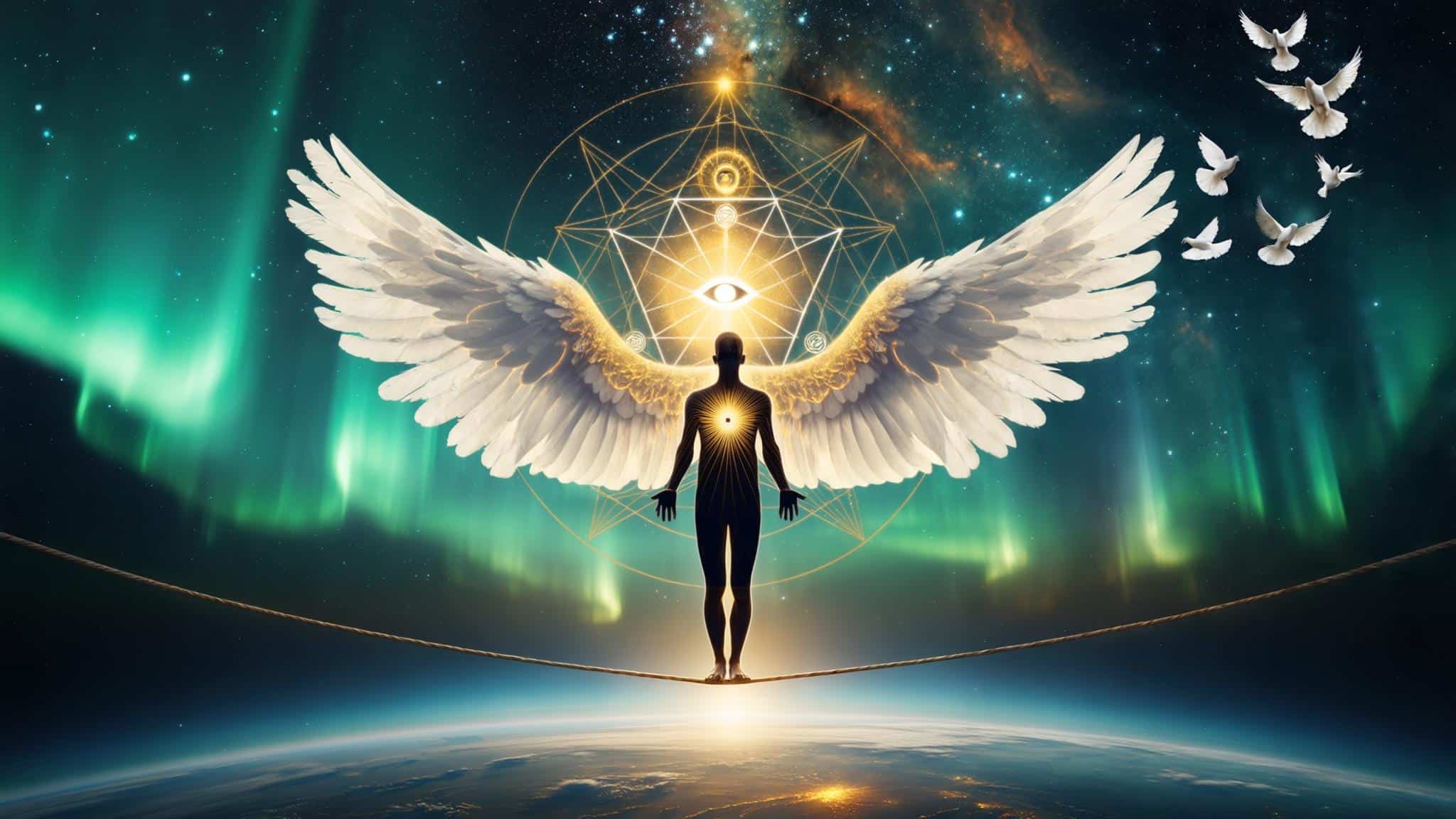
At this point, picture two skilled acrobats. One performs every move on the rope by himself but never considers his partner’s balance; in the end both of them fall (Irresponsible Freedom). The other, terrified that his partner might fall, freezes trembling where he stands and cannot move an inch (freedom-less, fear-filled Responsibility). The ideal acrobats, however, are those who cross to the other side safely by taking into account the wind on the rope, their own strength and the weight of their partner (Responsibility) — while at the same time dancing across the rope with the courage and joy of a swan (Freedom).
Conclusion: The Two Wings of Evolution
Freedom and Responsibility are two sound wings that lift us out of the illusions, the selfishness and the mechanical behaviors of the coarse material world and carry us to a true and luminous level of “Consciousness.” When one of these wings is missing or broken, the soul cannot fly; it is merely tossed about on the winds of life and suffers endlessly within itself.
Healing these psychological wounds, which Cüceloğlu pointed to with peerless insight, is possible only through the act of “Knowing Oneself” — the very act emphasized together throughout the works of Dr. Bedri Ruhselman and Ergün Arıkdal. We must let fall the mask of the spoiled tyrant within, or of that downtrodden false personality forever trying to please everyone. At that flawless point of balance — where we face our own truth, where we protect each person’s right as if it were our own, and where we also honor our own existence — we will each become both a free traveler and a responsible servant of this immense realm.
REFERENCES
- Cüceloğlu, Doğan. Instagram post (@dogancucelogluofficial), “Responsibility and Freedom.”
- Nicoll, Maurice. Psychological Commentaries on the Teaching of Gurdjieff and Ouspensky.
- Ouspensky, P. D. The Psychology of Man’s Possible Evolution.
- Ruhselman, Dr. Bedri. İlâhi Nizam ve Kâinat (The Divine Order and the Cosmos).
- Ruhselman, Dr. Bedri. Mukadderat ve İcabat (Destiny and Its Requisites).
- Arıkdal, Ergün. Kendini Bilmek (Knowing Oneself).
- Arıkdal, Ergün. Varlıksal İlkeler (Existential Principles).