
⏱ 10 min read
Throughout human history, few concepts have been as widely debated, deeply pondered, and profoundly misunderstood as destiny. Most people think of fate as a rigid script etched into our foreheads at birth — something we can never change, leaving us helpless before the whims of the universe.But when we dive into the depths of diverse spiritual, philosophical, and mystical traditions, a radically different picture of fate and free will emerges: Destiny is not a blind decree. It is a magnificent system of growth and spiritual evolution, shaped by our own free will and governed by divine justice. In this exploration, we will examine the profound connection between fate and free will through the lens of sources that appear different on the surface yet point to the same universal truth.
The Fatalism Fallacy and the Reality of Determinism
To properly understand destiny, we must first set aside the most common distortion — fatalism.
As Dr.Bedri Ruhselman explains in his work Mukadderat ve İcabat (Destiny and Necessity), fatalism is the erroneous belief that every event in the world has been irrevocably decreed in eternity and that human will has no power to alter it — a view that reduces human beings to mindless automatons. Ruhselman rightly asks: if absolute fatalism were true, what meaning would effort, moral choice, or personal responsibility hold? How could a being held accountable for actions over which it had no control be reconciled with divine justice?
The true mechanism governing the universe is Determinism — the Principle of Causality. As Ruhselman elaborates in Ruh ve Kâinat (Spirit and the Universe) and Mukadderat ve İcabat, the law that governs the cosmos dictates that every action is the result of a preceding cause and the seed of a subsequent effect.Nothing we encounter in this world — not the slightest event — is a product of chance. In Ruhselman’s words, what we call fate or destiny is simply the harvest of seeds we ourselves have planted through our desires, will, and efforts, blossoming before us within the framework of these unerring divine laws. The question of fate and free will finds its clarity right here: it is not an invisible hand but our own actions and intentions that shape our destiny.
The School of Earth: Spiritual Evolution Through Experience
If we shape our own destiny, why do we sometimes endure lives of immense hardship and suffering? The answer lies in the very purpose of human existence on earth — tekâmül, or spiritual evolution. As Ergün Arıkdal beautifully summarizes in his work Tekâmül (Evolution), earthly life is a magnificent instrument serving the soul’s spiritual growth.We come here not for material satisfaction but to expand our spiritual capacity through experience — and we come repeatedly. According to Arıkdal, a single lifetime cannot meet the infinite needs of the soul. This is why reincarnation — rebirth within the deterministic chain of interconnected life conditions — is an essential necessity.
Michael Newton’s Destiny of Souls points to this same truth from a different angle: we are not victims. Before coming to earth, we ourselves — with our own free will and the guidance of our spiritual mentors — choose which body to inhabit and which challenges to face. As Newton’s research reveals, most people knew about the difficult struggles of their coming lives beforehand and requested them with solid reasons for their own spiritual development. The sufferings of this world, as part of the balance between fate and free will, are educational materials that ripen our souls.
Karma: Not Punishment, but a Compassionate Teacher
In Eastern philosophy, the principle that we reap what we sow is called “Karma.” Most people perceive karma as a heavy punishment handed down from above. Yet understanding the relationship between fate and free will requires grasping karma correctly: as Edgar Cayce states in Many Mansions and related works, karma is absolutely not a fatalistic or punitive mechanism.
It is a compassionate and spiritual educational system that guarantees justice and ensures spiritual evolution. As Cayce emphasizes, the principle “whoever kills by the sword shall also perish by the sword” exists so that humans may learn — by feeling within themselves — what it means to inflict suffering upon others.
Similarly, the spirit guide Silver Birch, in Light from Silver Birch and Wisdom from the Other Side, conveys the same truth in different words: the law of cause and effect operates unfailingly throughout the universe. Every harm we inflict on others, knowingly or unknowingly, must eventually be balanced.
According to these guides, the purpose of this law is not to bear grudges against humanity — it is to teach us attentiveness, compassion, and ultimately how to reach a divine love. The difficulties we face while repaying debts from the past are opportunities for our souls to break free from their chains.
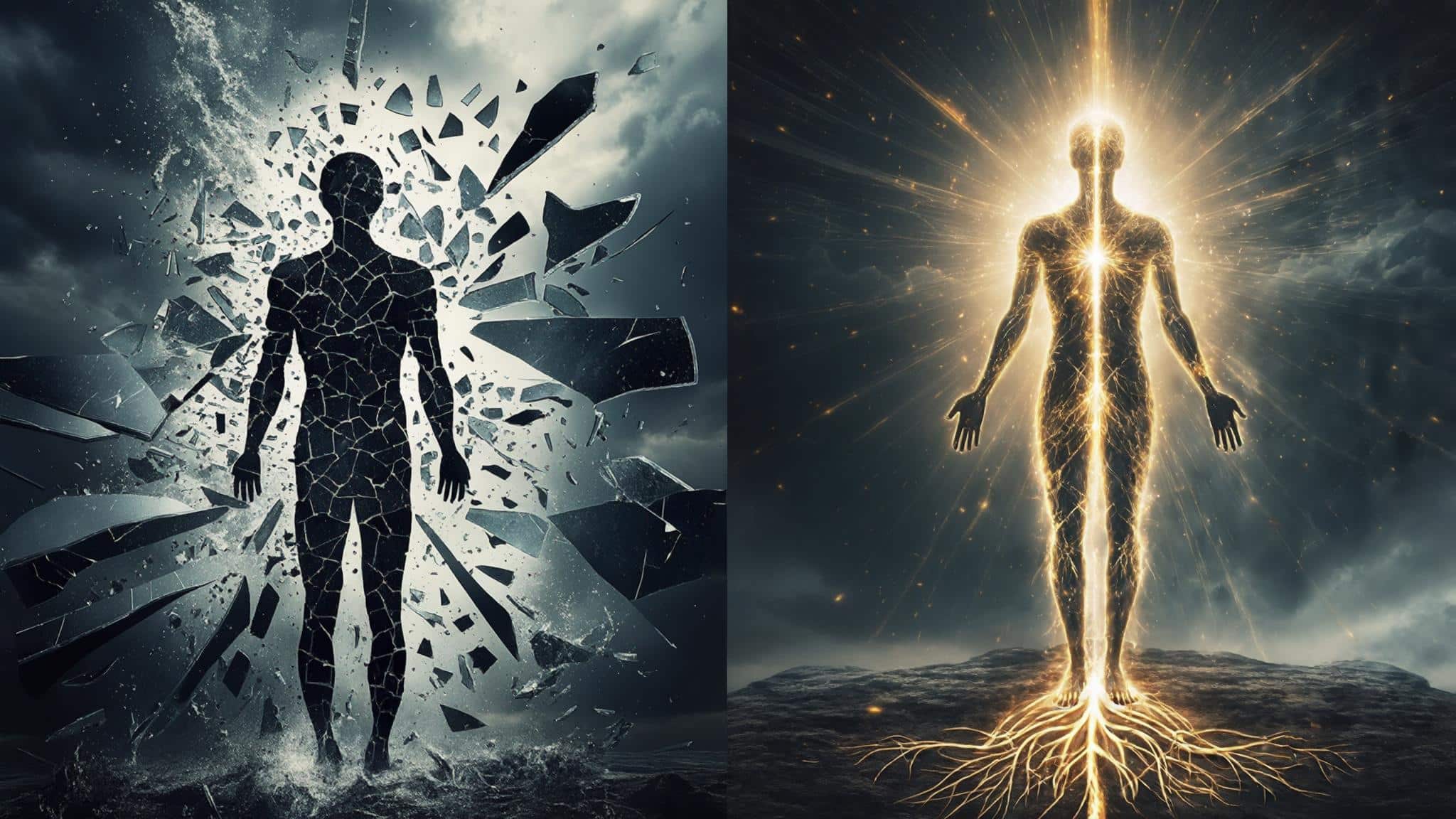
The Law of Accident and the Law of Fate: The Sleeping vs. the Awakened
One of the most illuminating perspectives on destiny and free will is the view that human beings are subject to different cosmic laws depending on their level of inner awakening. As P.D.
Ouspensky explains in The Psychology of Man’s Possible Evolution and Maurice Nicoll elaborates in Psychological Commentaries on the Teaching of Gurdjieff and Ouspensky, the ordinary person — living mechanically and asleep to their true nature — does not actually have a real destiny.Such a person is subject to the Law of Accident: living disconnected from their essence and true purpose, buffeted by random external influences, imitating others, and operating through a false personality — the ego. As Nicoll puts it, a person living through their false personality is like a leaf blown about in the wind: at any moment, a random accident or disaster may befall them, entirely beyond their control.
But when a person begins to awaken — when they strip away their false masks and discover the real potential within, their Essence — everything changes. As they stop reacting mechanically to external events and become conscious, they move from the Law of Accident to the Law of Fate.
Fate, in this context, is not something to fear but rather an inner, protective law that guides us toward our true purpose of existence. As Ouspensky states, only when a person returns to their Essence and gains true will do they acquire the power to build their own destiny and future. While the sleeping person is a plaything of coincidence, the awakened person — having gained awareness of fate and free will — becomes the master of their own true destiny.
The Sufi Perspective: Knowledge Follows the Known
We find this inner dimension of destiny reflected with equal depth in the teachings of Muhyiddin Ibn Arabi, one of the towering figures of Islamic mysticism. In works such as Fusus al-Hikam (The Bezels of Wisdom), Lubb al-Lubb (The Kernel of the Kernel), and Tafsir al-Kabir, Ibn Arabi presents a striking perspective on fate: God has not written an arbitrary destiny for any being.
One of the greatest secrets Ibn Arabi reveals in Fusus al-Hikam is the principle “Knowledge follows the known” (al-ilm tabi’ lil-ma’lum). This means that God knows a being’s destiny by looking at the potential and inherent demands contained within that being’s eternal archetype (A’yan al-Thabita) in divine knowledge, and manifests accordingly.
Ibn Arabi states that everything that befalls a person actually originates from their own essence and states — neither good nor evil comes to a servant from anyone other than their own soul. The Creator (al-Haqq) grants each being the opportunity to manifest in the direction of their own inherent aptitude and desire.
Therefore, we should evaluate misfortunes not by searching for external culprits but by turning inward, understanding them as reflections of our own developmental needs. Fate and free will find their meaning in this divine mirror. The universe is a vast divine mirror in which the reality of fate and free will allows every being to experience its own essential truth.
Fate and Free Will: The Power to Change the Future
In light of all that has been discussed, a fair question may arise: “Given our karma from the past and the plans we made before birth, are we helpless puppets in this life?” The answer given in Ergün Arıkdal’s Kendini Bilmek (Knowing Yourself) and Tekâmül series, as well as in Silver Birch’s Wisdom from the Other Side, is unequivocal: Absolutely not! The truth about fate and free will is clear: humans possess free will at every moment.
As Silver Birch underlines in Wisdom from the Other Side and There Is No Separation in Love, yes, our free will is not infinite or unlimited. It is framed by universal laws and the karmic burdens we carry from the past.Some events and challenges we will face may have been sealed — predetermined — as consequences of previous actions. However, free will lies in how we respond to these conditions. Faced with the same difficulty, we can rebel and rage, making our karma even heavier — or we can meet that challenge with love, patience, and understanding, passing that test successfully.
As stated in the Sadıklar Planı Tebliğleri (Communications from the Faithful Plan), using our will in the right
direction — listening to the voice of our conscience — increases our merit and carries us to a new, more luminous stage of evolution. As Edgar Cayce beautifully summarizes, will is the sole governing element that possesses the power to alter the pattern and destiny created by the soul’s previous activities.
Like a lion confined to a cage, we may have certain limitations — but how we behave within that cage is entirely up to us. When we infuse our choices and thoughts with love and compassion, we hold the power to beautify our future line of destiny.
Conclusion: We Are the Architects of Our Own Destiny
To sum up, the shared message of all these deep wisdom sources is this: Destiny is not a tragic play written by someone else and forced upon us. Dr. Bedri Ruhselman, Ergün Arıkdal, Gurdjieff, Ouspensky, Ibn Arabi, Edgar Cayce, and Silver Birch — the common ground where these luminaries from different traditions converge is clear: fate and free will are a magnificent synthesis of the unerring justice of cosmic laws and the choices we have made from past to present with our own volition.
No suffering in our lives is in vain; no encounter is coincidence. They are all educational opportunities placed
before us to awaken the Essence within, to break free from the chains of ego and false personality, and to reach universal love.
We cannot escape our destiny, but by understanding it and making our conscience, reason, and love our guides at every moment, we can become captains of our own ship of evolution. We are not the helpless pawns of the universe — we are powerful beings with the potential to make a new beginning at any moment, lovingly embracing the responsibility of our own destiny.
References:
- Ruhselman, B. — Mukadderat ve İcabat (Destiny and Necessity), 1953, Kültür Basımevi, Istanbul.
- Ruhselman, B. — Ruh ve Kâinat (Spirit and the Universe), 3 vols., 1946, Gayret Kitabevi, Istanbul.
- Arıkdal, E. — Tekâmül (Evolution), 1999, Ruh ve Madde Yayınları, Istanbul.
- Arıkdal, E. — Yaşamın Amacı Kendini Bilmek (Knowing Yourself), 1998, Ruh ve Madde Yayınları, Istanbul.
- Newton, M. — Destiny of Souls, 2000, Llewellyn Publications.
- Cayce, E. — Many Mansions (compiled), A.R.E. Press.
- White Eagle — The Light Bringer, 1993, White Eagle Publishing Trust.
- Silver Birch — Light from Silver Birch, 1982, Psychic Press.
- Silver Birch — There Is No Separation in Love, Ruh ve Madde Yayınları, Istanbul.
- Ouspensky, P.D. — The Psychology of Man’s Possible Evolution, 1950, Hedgehog Press.
- Nicoll, M. — Psychological Commentaries on the Teaching of Gurdjieff and Ouspensky, 5 vols., 1952-1956, Vincent
Stuart. - Ibn Arabi, M. — Fusus al-Hikam (The Bezels of Wisdom), trans. R.W.J. Austin, 1980, Paulist Press.
- Ibn Arabi, M. — Kernel of the Kernel, trans. Ismail Hakki Bursevi, Beshara Publications.
- Ibn Arabi, M. — Tafsir al-Kabir, 2 vols., 2007, Kitsan Yayınları, Istanbul.
- Sadıklar Planı Tebliğleri (Communications from the Faithful Plan), 1983, Ruh ve Madde Yayınları, Istanbul.
Listen While You Read
Frequency Odyssey — Complete Brainwave Journey
Universal laws and evolution — the complete spectrum of consciousness — a 2-hour meditation journey spanning all consciousness layers.
Sonat Mundi — United Colours of Sound | Meditation & consciousness music