⏱ 10 min read
An esoteric reading of the morning on which it is not an animal, but the ego, that is slain
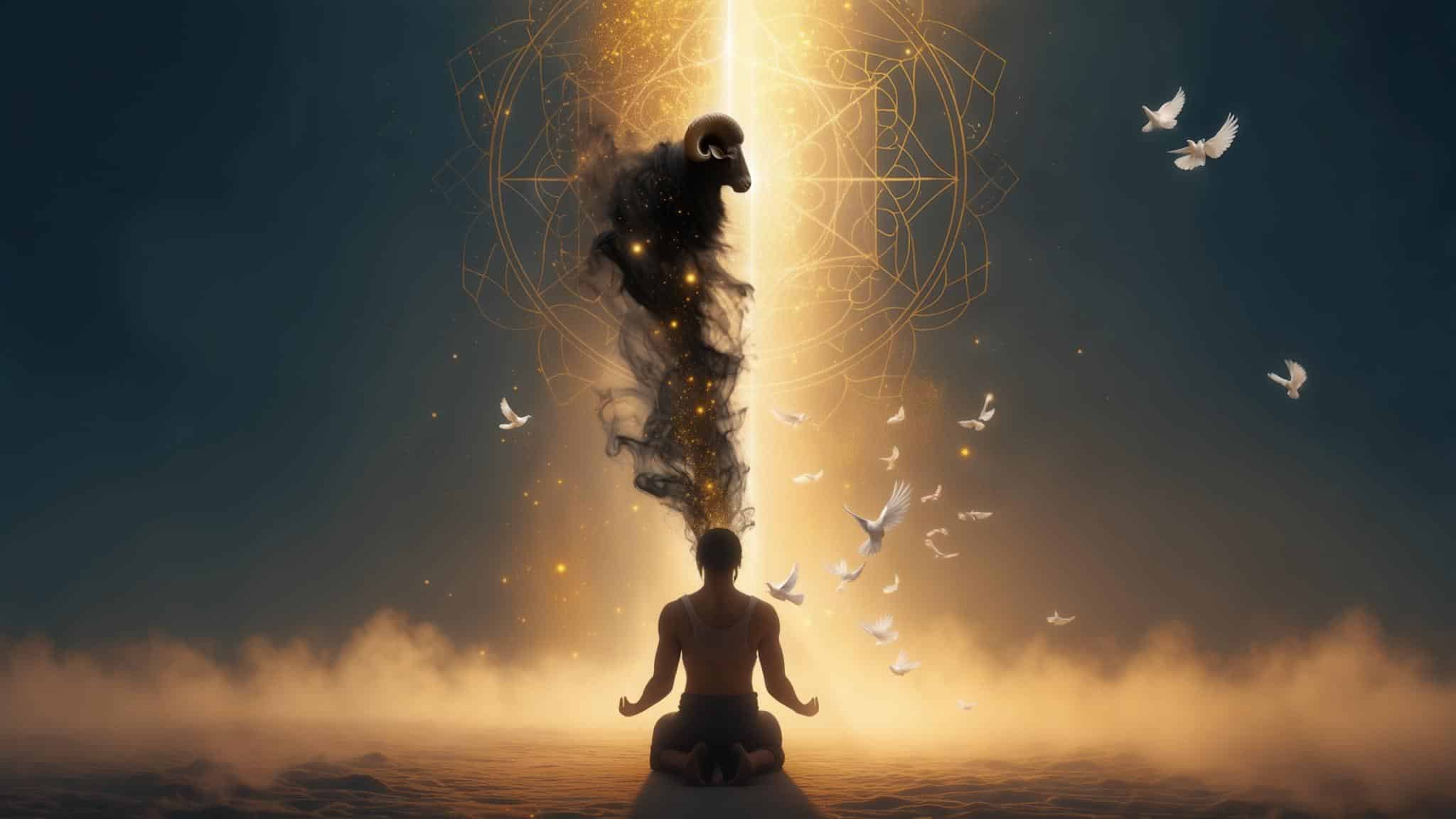
The Feast of Sacrifice (Eid al-Adha), within the immense rhythm of the cosmos, is a symbol of unity and togetherness that carries profound meaning for the entire Muslim world. Yet the inner, esoteric meaning of sacrifice lies far beyond this outward scene; it is hidden in a journey the human being makes directly into the self. In its traditional, formal sense, sacrifice is known as the ritual offering of an animal, the shedding of its blood, and the sharing of its meat with those in need. But amid the rush of daily life, we so often overlook the vast universal truth that lies behind this rite.
Seen through the window of spiritual and esoteric wisdom, the act of sacrifice is not merely a physical deed. It is a magnificent symbol of the greatest step the human soul must take on its journey of evolution.
Before we begin our existential analysis, it helps to recall the true meaning of sacrifice. The word qurban means, at its root, “to draw near” — to become close to God. The sacred sources stress that the real aim of sacrifice is not the shedding of blood; it is for the human being to slaughter, for the sake of the divine will, the coarse, selfish and primal nature within — the nafs, the ego. The true sacrifice is the effort to reach spiritual purity and God-consciousness by offering up one’s own bad traits, pride, anger, excessive attachment to matter, and false personality. The slaughtered animal, in turn, is nothing but an externalized, concrete representation of the still-unrefined primal drives within us.
Now let us unravel the esoteric meaning of sacrifice, step by step, in the light of universal laws and timeless sources.
Abraham’s Trial: What Is Truly Being Sacrificed?
The historical and symbolic origin of the rite of sacrifice goes back to Abraham being asked, in a dream, to offer his son. In the outward reading, this is a father’s trial — to surrender his child at God’s command. But in the esoteric, spiritual reading, the reality the story tells is far more shattering.
As Ibn Arabi points out with great subtlety in his immortal masterpiece Fusus al-Hikam (The Bezels of Wisdom), Adam, Eve and their child are nothing other than the fragmentation and reunion of a single being. Since mother, father and son come from the same origin, the same essence, a father sacrificing his son in a dream is in truth the sacrifice of his own part — and therefore of his own ego. Ibn Arabi notes that Isaac appeared to his father in the dream as a human being, yet in the world of the senses as a “ram”; and that the ram which was slain was in reality Abraham’s own ego. The prophet’s tremendous act of devotion for the sake of nearness to God was not the slaughter of a physical ram descending from heaven, but the power to sacrifice his strongest bond, his most powerful worldly love, for the sake of the divine.
For example: picture a person who has devoted his entire life to his career, his title and the money he has earned, building his whole identity upon these worldly achievements. That status is, for him, like a beloved “child” he would do anything to protect. One day his conscience asks him to stand against an injustice — even at the risk of losing this cherished position. The moment he pushes that position away with the back of his hand rather than commit a wrong, he sacrifices his greatest weakness for the sake of divine justice. The peace that then descends from above is the instant the ego is slain and the conscience is set free.
From Form to Essence: It Is Not the Animal but the Primal Drives That Are Slain
The school of the world is a vast laboratory established for the soul to know and purify itself. In this laboratory the human being’s greatest enemy is again himself — the animal instincts, ambitions and insatiable desires he carries.
In Ibn Arabi’s peerless esoteric commentary (Ta’wilat), the spiritual dimension of sacrifice is explained in magnificent terms: to reach God, the human being must “send forth the sacrifice of the ego and slaughter it beside the Kaaba of the heart.” As the work states, the true aim of offering the larger animals is for the human being to slaughter the noble yet stubborn, unyielding animal of the ego within — with the spears of opposition and the knives of inner struggle — and so surrender it to God.
The meaning of the act is summed up in a luminous line: “Mention the name of God over them by clothing yourselves in His attributes and by annihilating your own attributes within His attributes. To sacrifice in the way of God is precisely this.” In other words, while we believe we are pressing the knife to an animal’s throat, on the spiritual plane we are bound to slaughter the offering of our own self. Until we cut away the insatiable pride within, the coarse arrogance that says “I know best,” the sharp tongue forever criticizing others, the blood we shed has no value in the universal order. Indeed the Quran declares, “Neither their flesh nor their blood reaches God; but your righteousness reaches Him” — placing at the center not the physical deed but the spiritual intention, the essence.
An analogy from life: imagine a master sculptor standing before a great block of marble. That block — which is our coarse ego and animal drives — holds within it a flawless human statue, the Perfect Human. Every rough, jagged piece the sculptor chips and casts away with chisel and hammer is, in truth, an act of sacrifice. As the excess — anger, hatred, lust, lies — is cut away, what remains is that smooth, divine work of art: the true “Human.”
The Esoteric Meaning of Sacrifice and Its Place in Universal Evolution
In Pozitif Yaşam (Positive Living), the Turkish spiritual master Ergün Arıkdal offers a revolutionary explanation of sacrifice. As Arıkdal emphasizes, had the true meaning of offering a sacrifice been genuinely understood by human beings, the act would long ago have ceased to be a physical command.
Because for centuries people have focused only on the outward side of sacrifice, never quite realizing “what is to be sacrificed” within, the divine system has kept this symbolic rite alive in human life as a ritual. Yet what the universal mechanism of governance asks of the human being is that he sacrifice the ignorance, the torpor and the selfish desires that obstruct his own evolution. If the human being wishes to rise toward that great Unity, that Creative Force in the cosmos, he must give up the false values that weigh down his feet. Otherwise, shedding the blood of thousands of animals year after year cannot carry him a single step beyond his automatic, machine-like, sleepwalking existence.
A Psychological Purification: Sacrificing Negative Emotions
Another great dimension of sacrifice is psychological. All of us constantly produce negative emotions in daily life. We take offense, we feel hurt, we believe we have been wronged, we gossip, and within ourselves we ceaselessly judge others.
As Maurice Nicoll explains in his monumental series Psychological Commentaries on the Teaching of Gurdjieff and Ouspensky, the idea of sacrifice — of giving up — is present in all esoteric teachings. But these teachings ask the human being to sacrifice not sheep or cattle, but his own suffering, his negative emotions, his craving to be proven right. As Nicoll rightly observes, if you sincerely give something up — if you sacrifice it — you give it the chance to transform into a higher force. The human being is so in love with his own pain and negative emotions that to give them up feels like dying. The anger we nurse within, crying “how could they do this to me!”, is in fact the most pampered pet we keep. And the true feast, the true morning of sacrifice, is the morning on which a person can — with an Abrahamic surrender — mercilessly cut away this anger, this taking of offense, this “I am right” pride. When you sacrifice that negative energy within, it is set free, leaps to a higher level, and is reborn within you as understanding, compassion and insight.
An example from everyday life: imagine someone who fell out with a relative years ago over a trivial word, and has grown a mountain of anger and resentment toward them in the heart — a resentment that quietly gnaws at him from within. The morning of the feast arrives. This person may believe he has fulfilled his religious duty by slaughtering a physical ram and distributing the meat. Yet the real sacrifice is for him to take up the phone and, with a single stroke of the knife, cut down the pride that whispers “but they should have made the first move, I am the one who is right” — and to call that relative and say, “I forgive you; happy holiday.” Where pride is sacrificed, the flower of love blooms.
The Inner Meaning of Sharing the Sacrificial Meat
An inseparable part of the rite of sacrifice is the distribution of the meat to the poor, the needy and one’s neighbors. In terms of social solidarity this is a magnificent act. But what is its spiritual, cosmic dimension? Whom, and with what, are we truly to feed?
Ibn Arabi’s luminous commentary on these verses runs thus: the sacrificial meat is the very good character, the faculties and the spiritual gains a person attains by striving on the path of God. The command to “feed the poor” therefore means not only the one whose stomach is empty, but feeding those who have gone hungry in terms of spiritual and moral virtue — our own inner powers, grown weak and faint from lack of cultivation, as well as the unaware people around us.
In other words, the one who has truly sacrificed something must distribute the spiritual light, love and tolerance he has gained to those around him who hunger for the spirit. Not breaking a person’s heart, listening to someone weary and burdened, breathing hope into them — this is to feed the meat of the inner sacrifice, that is, one’s compassion, to a soul in need. To share spiritual knowledge with those seeking the truth, to illuminate the darkness of their ignorance, is the greatest offering one can give.
Conclusion: The Feast of Awakening
As Dr. Bedri Ruhselman strives to awaken us to in his profound work Mukadderat ve İcabat (Destiny and Its Requisites), all of a human being’s actions and behaviors are a requisite of the Laws of Divine Will; everything is arranged so as to widen the being’s merit.
On the Feast of Sacrifice, let us cease to be sleepwalking beings who merely perform a ritual, and open our consciousness to universal truths. Let us realize that the thing to be slain is the pride, selfishness, lies, laziness and lovelessness we have fattened within ourselves for years. As we approach a physical animal with respect and gratitude, let us not forget that the place where blood must truly flow is our own ego.
To the measure that we surrender our weaknesses to the divine laws and sacrifice them, we will grow lighter; and in this school called the world — freed from fears, from pain and from mechanical reactions — we will each become a free, luminous and compassionate conscious human being: the Perfect Human (Insan-i Kamil).
May you live a true resurrection, in which the selfish and coarse “I” within is sacrificed and, in its place, a loving, universal and luminous “We” is born. May your Feast of Sacrifice be an occasion for your spiritual awakening.
REFERENCES
- Ibn Arabi, Muhyiddin. Fusus al-Hikam (The Bezels of Wisdom).
- Ibn Arabi, Muhyiddin. Ta’wilat (Esoteric Quranic Commentary).
- Nicoll, Maurice. Psychological Commentaries on the Teaching of Gurdjieff and Ouspensky.
- Ruhselman, Dr. Bedri. Mukadderat ve İcabat (Destiny and Its Requisites).
- Arıkdal, Ergün. Pozitif Yaşam (Positive Living).