⏱ 4 min read
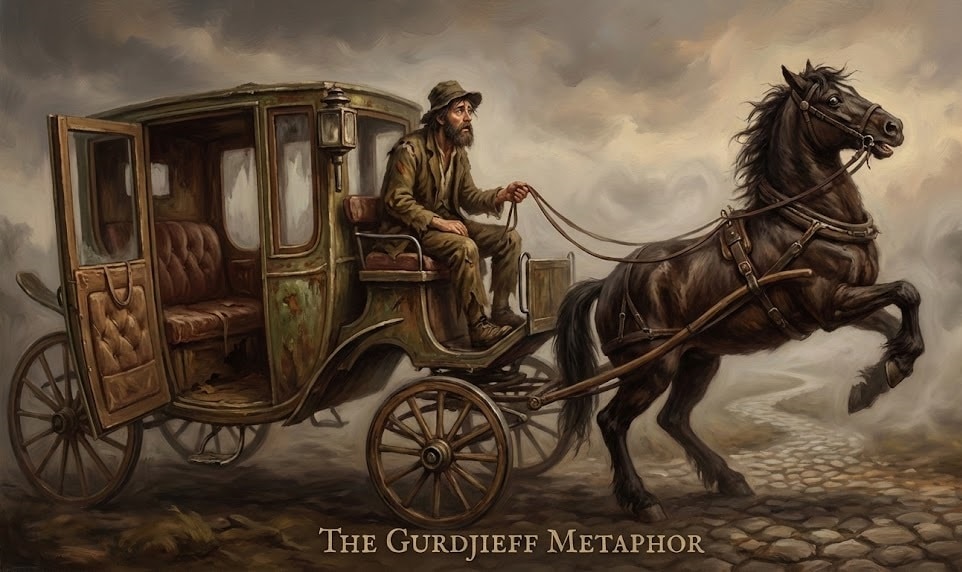
Is a human being a monolithic entity composed of a single “I”? Or does one harbor a “crowd” within, speaking different languages and constantly fighting for authority? The “Fourth Way” teachings of G.I. Gurdjieff and P.D. Ouspensky explain the tragedy of man through this internal fragmentation. To understand this, we use the famous metaphor of the “Carriage, Horse, Driver, and Master.”
Understanding the role of the Carriage Horse Driver is essential for personal growth.
The Driver: The Intellectual Center
The Driver represents our Intellectual Center (the Mind). His duty is to know the way, make decisions, and manage the horse. However, the Driver has a dramatic problem: he is usually in the “tavern.” The tavern symbolizes daydreams, theories, and the mechanical functioning of the “formatory apparatus.”
The Carriage Horse Driver must learn to communicate effectively with both the Horse and the Carriage.
The Driver’s biggest mistake is assuming that a decision made in the mind will be immediately understood by the Horse (Emotions). There is no common language between the mind and emotion; the Driver shouts in words, but the Horse only understands the language of imagery and feeling.
The Horse: The Emotional Center
It is crucial for the Carriage Horse Driver to understand the emotional state of the Horse to guide the journey.
Understanding the Role of the Carriage Horse Driver
The dynamic between the Carriage Horse Driver and the Carriage is vital for movement. (Also read: 7 Categories Of Man)
The Horse is our Emotional Center, the actual source of energy that pulls the carriage. Gurdjieff and Ouspensky state that the Emotional Center can function 30,000 times faster than the Intellectual Center. This massive speed difference explains why our emotions take control long before our minds can process a crisis. Our Horse is often untrained—filled with negative emotions and childhood conditioning. Because the “reins” (the connection) are broken, man cannot emotionally do what he intellectually knows to be right.
The Carriage: The Moving and Instinctive Centers
The Carriage represents our physical body—the Moving and Instinctive centers. The success of a journey depends on how well the Carriage Horse Driver manages the Horse.
- Moving Center: Manages external movements and learned motor skills.
- Instinctive Center: Manages internal vital functions like heartbeat and digestion.
The Carriage has its own “intelligence” or cunning; it loves comfort and dislikes change. If the Carriage is “rusty” or the connection to the Horse is weak, movement does not occur regardless of the Driver’s intent.
The Master: Where is the “Real I”?
The Master (The Real I or Will) is usually absent. Man is asleep. In the Master’s absence, temporary “I’s” (small ‘i’s) take the driver’s seat and give contradictory orders.
There are also two higher centers: the Higher Emotional Center and the Higher Intellectual Center. These are fully functional within us, but our lower centers (Driver, Horse, Carriage) are too noisy and unorganized to receive their “high voltage” signals. We cannot hear the Master’s voice because of the internal bickering.
Synthesis: Repairing the Connections
Training the Horse is a primary task for the Carriage Horse Driver to achieve harmony. The Carriage Horse Driver must also maintain the Carriage for optimal performance.
A successful Carriage Horse Driver balances all three elements: the Driver, the Horse, and the Carriage.Ultimately, the Carriage Horse Driver must strive for unity between their internal selves to move forward.Understanding the Carriage Horse Driver’s role enables us to navigate our own inner landscapes effectively.
What does “human development” mean in this light?
- Awakening the Driver: The mind must leave the “tavern” of imagination and realize the poor state of the Horse and Carriage. Work begins in the Intellectual Center.
- Repairing the Reins: The Driver must learn the Horse’s language through Attention and Self-Remembering.
- Balance: The goal is to become a “Balanced Man”—one whose Driver is awake, Horse is obedient, and Carriage is well-maintained.
Conclusion: Unity of the Whole
Inner conflict arises because our mind, heart, and body are out of sync. Freedom is establishing the correct hierarchy among these three “minds” so that the Master (Soul/Conscience) can finally step into the carriage. As Gurdjieff said: “The Driver must hear, the Horse must feel, and the Carriage must go.”
Note on Sources: The concepts of “Centers,” “Speed Differences,” and “Higher Centers” in this analysis have been compiled from the works of G.I. Gurdjieff, P.D. Ouspensky, and Maurice Nicoll (specifically In Search of the Miraculous and Psychological Commentaries on the Teaching of Gurdjieff and Ouspensky). Furthermore, these topics are part of the second-year curriculum of the “Self-Knowledge” courses at the Ergün Arıkdal Spiritual Research Institute.
Join the Discussion: I invite you to share your reflections and engage with a global community of seekers on my [Medium page]. Let’s explore the laws of the inner garden together.
Listen While You Read
Gamma Consciousness — 40 Hz Peak Awareness
Inner integration of carriage-horse-driver-master — gamma integration — music for mental clarity and inner unification.
Sonat Mundi — United Colours of Sound | Meditation & consciousness music