⏱ 9 min read
The heart is the throne of God,
God looked upon the heart;
If you have broken a single heart,
Both worlds lay in ruin.
Whoever has broken a heart,
Will see neither grave nor bridge,
If the beloved sought is the divine countenance.
These deathless lines by Yunus Emre, the 13th-century Anatolian mystic poet, are considered the very pulse of Anatolian wisdom and Sufi thought. In a few brief verses he opens an entire metaphysics: the heart as divine throne, the cosmic gravity of compassion, and the silent ruin that follows the wounding of another. To read these lines slowly is to step into a vast inner geometry where every human encounter becomes a sacred event.
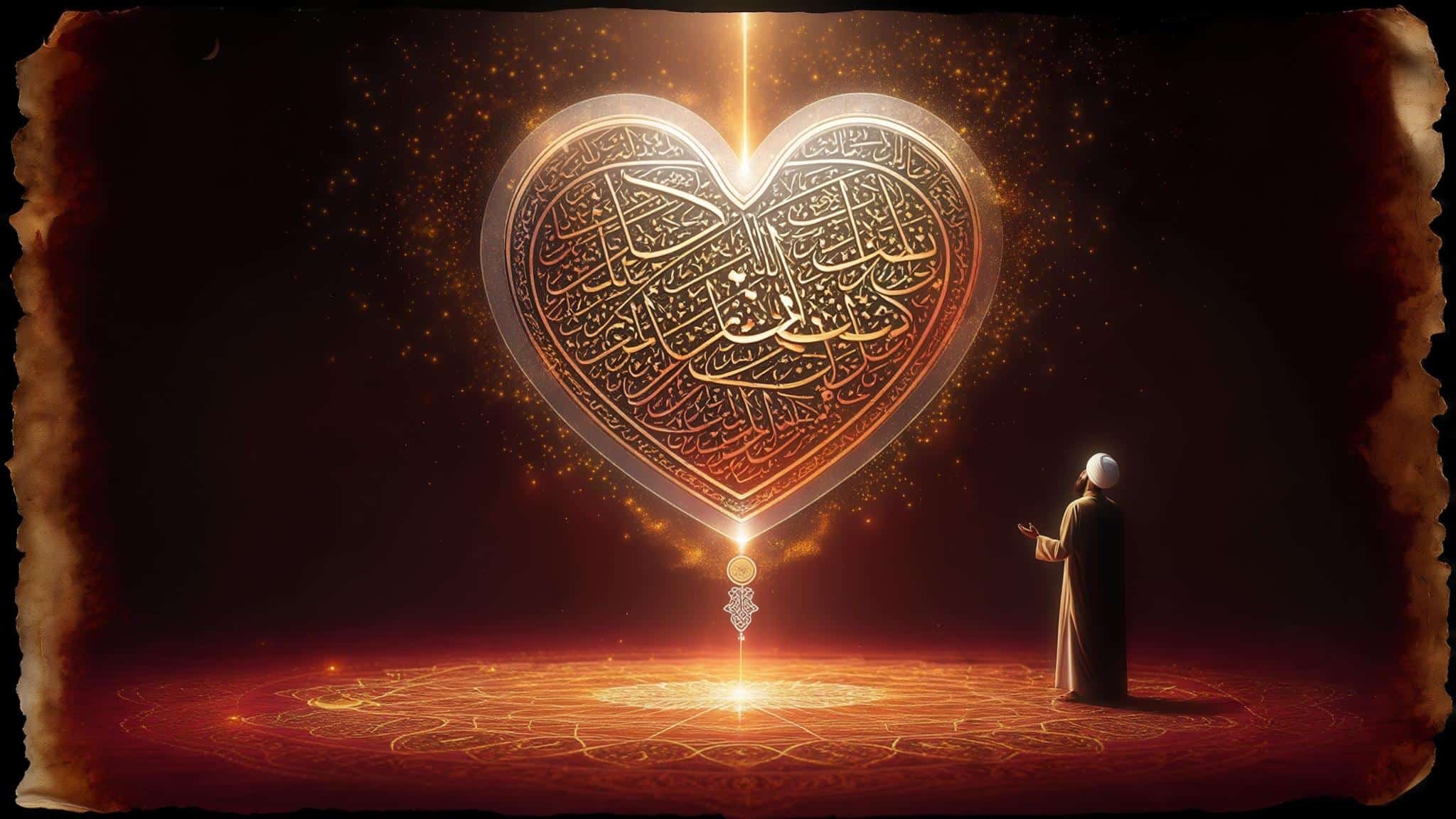
The Heart as Divine Throne: A Sacred Headquarters
The expression “the heart as divine throne” reveals that the human inner world is not an ordinary center but the most exalted station where the Creator manifests. It echoes the famous sacred hadith of Islamic Sufism: “I did not fit into the heavens or the earth, but I fit into the heart of My believing servant.” The heart, then, is depicted as a throne — the seat upon which the true Sovereign of existence (Çalap, the Lord) is enthroned.
From this perspective, the second half of Yunus Emre’s couplet — “Whoever has broken a heart, two worlds lay in ruin” — becomes a moral and existential warning of cosmic proportions. The hierarchy of being itself is at stake: if the heart is the throne of God, then breaking another’s heart means shaking that very throne. The poet does not limit the cost of this act to this world alone; both this world and the hereafter (the two cihans) lose their meaning for such a person, dissolving into a wasteland.
The verses whisper a single, unmistakable truth: it is the inner sanctuary within human beings — not the outer temples of stone — that demands our reverence. To live with the awareness that a single resentful word or harsh gesture can be the equivalent of cosmic destruction is to begin walking the path of Sufi consciousness.
And then comes the deepest invitation: To be a mirror. When the Lord looks into the heart, what will be found there? Purity, or a heap of shattered fragments? Yunus Emre, in the simplest Anatolian Turkish, breathes the highest secret: we love the created for the sake of the Creator. The greatest worship is to enter a heart; the greatest loss is to fall out of one.
The Wahdat al-Wujud Perspective
When we approach these verses through the lens of Wahdat al-Wujud (the Unity of Being), Yunus Emre’s lines transform from a moral lesson into a profound ontology — a teaching on the very structure of reality and the station of Tawhid (oneness). Let us unfold each motif of the heart as divine throne through the truth of absolute Being.
1. The Heart and the Yearning of the Hidden Treasure
In the doctrine of Wahdat al-Wujud, the foundational truth is the famous hadith: “I was a Hidden Treasure (Kenz-i Mahfi); I longed to be known.” God created the universe as a vast mirror to fulfill this longing to be known. Among all these mirrors, the only one able to reflect the divine names and attributes in their fullness is the heart of Insan-i Kamil, the Perfect Human.
The heart is the divine throne precisely because Absolute Being (Vücud-ı Mutlak) witnesses its own perfection and beauty most purely there. The heart, in this sense, is not a place at all — it is the point of unity where infinity becomes intimate, where the boundless concentrates into the bounded.
2. The Divine Gaze: When God Looks at the Heart
When Yunus Emre writes “Çalap looked into the heart,” this gaze is not mere observation. It is a creative act. For God to look upon a place (Nazar) is for that place to be illumined, brought into being, made luminous.
“Looking” here implies no separation between observer and observed. In the Unity of Being, the gazing one and the gazed-upon are the same. To look upon the heart is for the divine light to manifest from itself to itself within that mirror. If the heart is purified of masiva — everything other than the One — then the gaze and the mirror become one. “When Çalap looked into the heart,” He was, in truth, beholding His own light upon His own throne. This is the station of Tecelli-i Zat, where the servant’s will has dissolved and only His Being remains.
3. Breaking a Heart Is Shattering Unity
Why is breaking a heart such a cosmic catastrophe? In Wahdat al-Wujud, every atom is a manifestation of the One; but the heart is His center. To wound a heart is not merely to upset a person — it is to deny the Absolute Being who manifests in that heart, to repudiate the very center of divine Oneness.
The heart-breaker falls into the trap of duality (shirk): seeing the other as something separate from God. This duality is the desolation of the soul itself. To break a heart is, in essence, to topple the divine throne in your own inner kingdom — and a sovereign who has overturned his own throne becomes a refugee in both worlds.
4. Two Worlds in Ruin: The Ontological Collapse
For the people of Wahdat al-Wujud, “this world” and “the hereafter” (the two cihans) are not two separate realities but two aspects of a single Truth. Their distinction lies in the human mind, in the duality and fragmentation we project onto experience. The “ruin” Yunus Emre points to is not external poverty; it is the cosmic exile of a soul that has severed its bond with its Source.
The heart is the berzah — the bridge — between these two worlds. When the heart breaks, that bridge collapses. The person can no longer perceive existence as one. The world becomes ruined because everything outside is now seen as enemy, stranger, “other.” A profound loneliness and fear take hold. This world becomes ruined: nothing remains but anonymous matter. The hereafter becomes ruined: the only door to the divine countenance is closed.
The heart is the place where God says “I” within the universe. To shake that station is to shake the foundation of one’s own existence. The one who builds hearts builds inner unity; the one who breaks hearts shatters his own truth and is lost in the noise of multiplicity (kesret).
5. Neither Grave Nor Bridge for the Heart-Breaker
“Whoever has broken a heart will see neither grave nor bridge if the beloved is the divine countenance.” Once we understand the heart as divine throne, this final line becomes luminous: for one who beholds the Beauty of the One in the mirror of the heart, neither the grave (annihilation) nor the bridge of judgment (Sırat) remains — for that one is already drowned in the ocean of Unity.
We see ourselves as separate bodies, separate names, separate lives. This is the veil of multiplicity. But when the veil is lifted, we find we are all waves of a single ocean, drinking from a single source. One wave striking another is, in truth, a turbulence the sea creates within its own body. The person across from you is the mirror of a part of you that you have not yet faced. To wound them is to throw a stone at your own reflection. When the mirror cracks, we crack with it. The frequency of their pain reaches us — for the soul is one.
Nazargâh: The Hidden Kaaba Where Glances Meet
The human being looks at the outer world — the realm of mulk, of forms — through the senses. But the Truth (Hakk) looks at the human inner world, the realm of melekût, through the heart itself. As the tradition narrates: “God does not look at your forms or your possessions, but at your hearts and your deeds.” This is no mere statement; it is the supreme secret of existence. The Creator of the universe does not take the boundless galaxies as His dwelling, but the protected sanctuary within a single human chest.
The Heart’s Test: Constant Attention
The divine gaze is not a guest that visits the heart for a moment and leaves; it is always there. For this reason, the highest courtesy among the people of the heart is to keep the house clean while the Owner is at home. Every alien love, every cloudy intention that enters the heart becomes a veil before that limpid gaze.
From Form to Meaning: Migration of the Soul
People weigh one another by clothing, position, or eloquence. But the divine gaze pierces all these shells and descends straight to the essence. This gaze does not strike ornate words; it strikes the sincerity behind them.
The Weight of Breaking a Heart
This is why wounding a heart is considered a heavier offense than tearing down the Kaaba itself. The Kaaba is built of stone and earth; the heart is the spiritual throne where Truth itself manifests, the place from which the divine gaze never departs. Forgiveness, in this light, becomes the act of restoring a throne.
“O traveler! The labor you spend smoothing your outer appearance — spend it also on cleansing your heart, the place He gazes into every moment. For the guest does not come for the paint on the door, but for the cleanliness of the table within.”
When the heart, like a mirror, becomes pure, the divine gaze that falls upon it begins to illumine not only that heart but everything that heart touches.
Mercy: The Art of Self-Completion
For the wise one who lives with this awareness, mercy is no longer a kindness but a matter of recognition. To show compassion to another is to mend a piece of yourself. To forgive someone is to untie a knot in your own soul.
Existence is a single fabric; pull a single thread and the whole cloth wrinkles. The one who wounds another is, with the scissors in his own hand, cutting the cloth of his own life.
So we must ask ourselves: when a human being sees the one across from them as a part of themselves, can the very concept of “enmity” find any room left in this world? When you understand the heart as divine throne — your own heart, and every heart you meet — the only road that remains is the long, luminous walk toward yourself, in the mirror of every other.
With love…