⏱ 6 min read
In the chaos of life, while walking the fine line of social relationships, one of the most frequently prescribed virtues is Existential Humility.
We grow up with advice like “be humble,” “be like the earth,” or “do not boast.” These teachings are a wonderful compass to protect us from the destructiveness of pride. However, as with any medicine, the dosage is of vital importance. To define humility correctly, one must first recognize its misconceptions. Working on this within ourselves and escaping the traps of the ego (nefsaniyet) is only possible through the awareness, consciousness, and discernment we acquire on the subject.
The Fine Line Between Virtue and Inferiority
Understanding Existential Humility in Our Lives
Humility means one who does not exalt their personality, does not put themselves forward, and is modest. Many people perceive humility as being embarrassed in the face of praise and denying their own talents. Yet, in both Eastern and Western philosophies, humility has always been seen as the most precious virtue. The greatest obstacle to evolution is the claim of the “ego.” One of the false selves within us is the tendency to see ourselves as superior to others.
Many of our behaviors in life are mechanical. If a person’s behavior stems from an “acquired conscience” — a template of being a “good person” adopted from society rather than from inner maturity — it is merely a mask. If humility transforms from a life philosophy into an erosion of personality, it traps us in a cycle of inadequacy.
True Humility is a State of Consciousness
The human mind creates “buffers” to avoid seeing its own contradictions. A person who is religious one day, angry the next, and compassionate the day after fails to see these inconsistencies. Humility is the courage to see these internal inconsistencies clearly through self-observation and to say, “I am not even a single person.” A truly humble person is one who has realized the depth of their own ignorance.
The modern world convinces us that we possess a fixed personality. However, travelers on the path of truth know that what makes us say “I” is often nothing more than the turmoil of the lower self.
“Man is a leaf blowing in the wind of the ego.”
If someone says a harsh word or criticizes us, we immediately get angry. If someone praises us, we instantly become proud and think we are different from others. Where does humility begin here? True humility is recognizing this inner disarray and asking: “Which of these emotions am I? What am I in reality? Am I these emotions, or is there a greater reality to my being?”
Seeing our false identities that change color according to every situation and liberating ourselves from their falsity leads us to “Unity” (Vahdet), to the true Self (The Essence). Just as stars become invisible when the sun rises; when the greatness of the Divine Truth dawns upon your heart, your small “ego” will vanish in the same way. Now take a deep breath and think: Is that thing which hurts or prides you right now truly yours, or is it just a passing shadow?
Balance: Dignified Nothingness (Vakar)
Humility is only shown before the Truth (The Divine). It is not bowing one’s neck and remaining silent with a mindset of “I am bad, I am helpless.” This is merely the ego’s way of saying, “Look how dervish-like I am”; it is the most ornate and deceptive form of pride. This state is also an indication of a lack of self-respect.
The wise person knows the secret of the saying, “Let not the heart see what the hand gives.” When the Soul realizes that what it gives is actually a “light” entrusted to it, it does not boast of giving (Vakar); it simply gives thanks for being an intermediary for that flow (Humility).
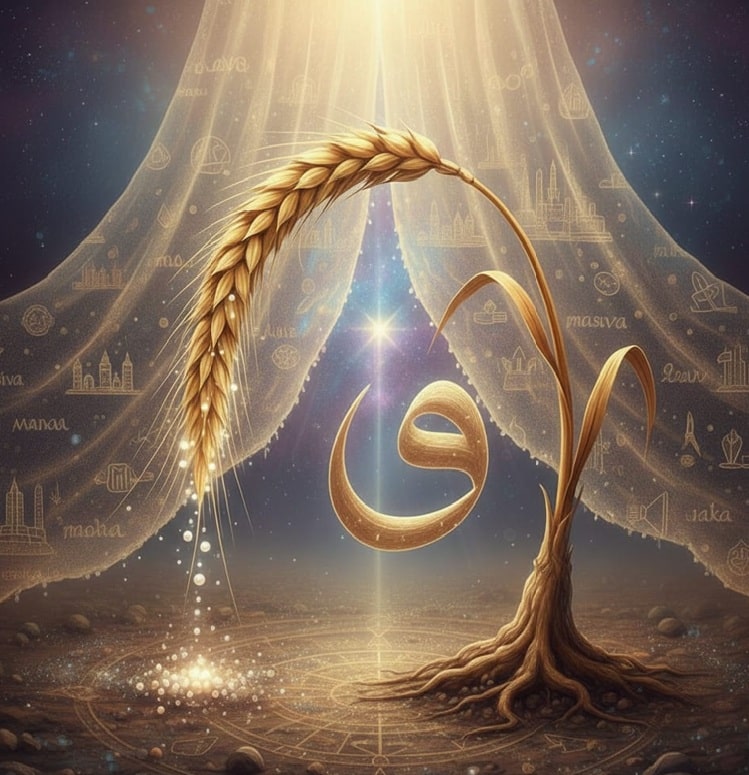
The Full Ear of Grain: The Station of “Waw”
As the grains of wheat ripen inside the ear, each one becomes heavy like a “star of wisdom.” At this very point, the ear shifts from a vertical plane to a curved form.
- The Symbolism of Waw: When the ear of grain bends, it resembles the Arabic letter “Waw” (و). Waw represents the posture of a human in the womb; it is the symbol of primordial helplessness and creation.
- The Divine Paradox: The closer the ear of grain gets to the sky (in terms of wisdom), the more it bends toward the earth (in terms of humility). This is a paradox: Spiritual ascent brings physical descent.
The one who possesses substance remains silent under the weight of the truth they know. This silence is not ignorance; it is reverence for the “word beyond words.” When the urge to prove your rightness arises in the middle of an argument, remember that curved posture of the grain. Truth does not need to be proven; it is already there. To remain silent is not to give up on truth, but to protect it from the noise.
- Dignity in Victory: When winning a success, bowing the head to the prostration of the soul, just as the grain bends in its fullest state. The consciousness that “This success is not mine, but a grace manifested through me” destroys pride.
- Dignity in Defeat: To be shaken but not to fall. To see defeat not as a humiliation, but as the temporary darkness of the seed entering the soil. To wait for the wisdom within that state without complaining or whimpering.
“Spiritual Posture” Practice for a Dignified Life
You can try this as an esoteric exercise: Whenever you feel excitement, anger, or excessive joy during the day, straighten your spine but tilt your head slightly (just a few millimeters) forward.
- Straight Spine: Represents your divine essence, your honor (izzet), and your unshakable dignity (vakar).
- Tilted Head: Represents your mortality, the transience of all things, and your humility.
This physical posture sends the following message to the nervous system: “I am here, I am at my center; my feet are firm on the ground, my head is locked onto the secret of the heavens. I am neither so rankless as to drown in the sea of the world, nor so ignorant of the Truth as to despise the creation.”
Join the Discussion: I invite you to share your reflections and engage with a global community of seekers on my [Medium page]. Let’s explore together.
Listen While You Read
Astral Voyage — Out of Body Sound Journey
Humility and transcendence — cosmic observatory perspective — music for transcending the boundaries of self.
Sonat Mundi — United Colours of Sound | Meditation & consciousness music